Chip-down vs module: which to choose?
When moving from a prototype to a production-ready embedded system, one of the most common crossroads I see engineers face is the choice between chip-down and modules, and oftentimes, I see teams make the wrong decision. The choice between the two depends on where you are in the product development lifecycle. Key factors such as budget and quantity also affect this decision. In this article, I will walk you through the distinction between the two design choices and which factors you should consider when making your decision.
“Chip-Down” vs “Module” Design
A module is a pre-built, pre-certified unit that integrates a wireless system-on-chip (SoC), surrounding RF circuitry, and passive components into a self-contained, shielded unit. Module vendors also provide reference designs that can guide you in placing their modules on your PCB. Vendors provide suggestions, such as the minimum clearance between the antenna on the module and the ground plane on your PCB, to achieve optimal RF performance. They usually provide design files of their development boards, so your team can use these as a reference when designing your own PCB. On the other hand, a chip-down design means your team is entirely responsible for placing the wireless SoC and the supporting circuitry on the PCB.
Modules dramatically compress your development schedule. RF is one of the most difficult categories of PCB design and can significantly delay timelines. By offloading this effort to a module vendor, your team doesn’t need to match traces or tune an antenna matching network, and you can save significant time in launching your product. The reduced development schedule can be invaluable for startups racing to validate their product concept or hit a crowdfunding deadline.
From a financial perspective, modules drastically reduce the upfront cost of launching your IoT product. An important step before launching your IoT product is to ensure it meets the certifications required by the appropriate governing authority. For example, in the US, this falls under the jurisdiction of the Federal Communications Commission (FCC). If your product is cellular-based, it will also need to be certified for use by the different cellular providers (e.g, Verizon, AT&T, T-Mobile in the US). Module vendors usually sell their modules pre-certified and absorb this cost. Even though you still have to certify your end product, the cost of using a pre-certified module is significantly less.
Finally, there is the matter of the supply chain. Modules can also significantly streamline your supply chain. Since a module is a single line item on your BOM, your team doesn’t need to source and manage all of the components that accompany the wireless SoC. Using a module simplifies the procurement and assembly process for low-volume production.
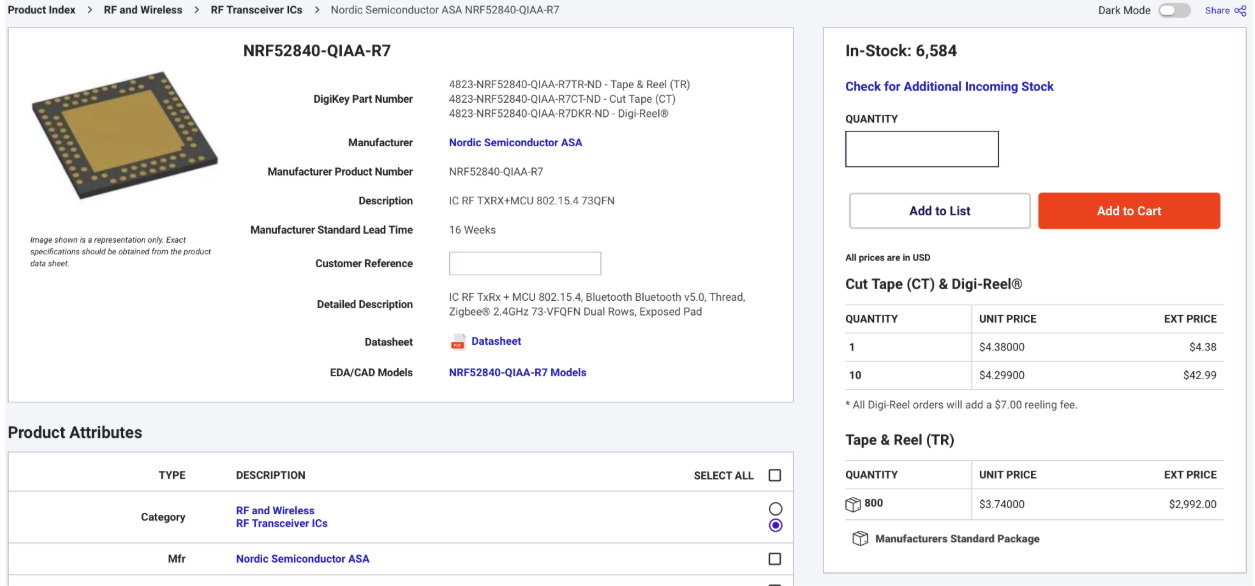
You may wonder why anyone would choose a chip-down design over a wireless module, given the advantages outlined in the paragraph above. Let’s search for a Nordic nRF52840 on Digikey to compare the cost of the SoC alone with that of a complete module. As shown in the image below, the baseline nRF52840 SoC costs $3.74 at production-level volume (>800 units) as of this writing.
If we identify the cheapest module in similar quantities from Digikey, we can see that the U-Blox module with an nrf52840 inside costs $7.26, more than twice the cost of the SoC alone!
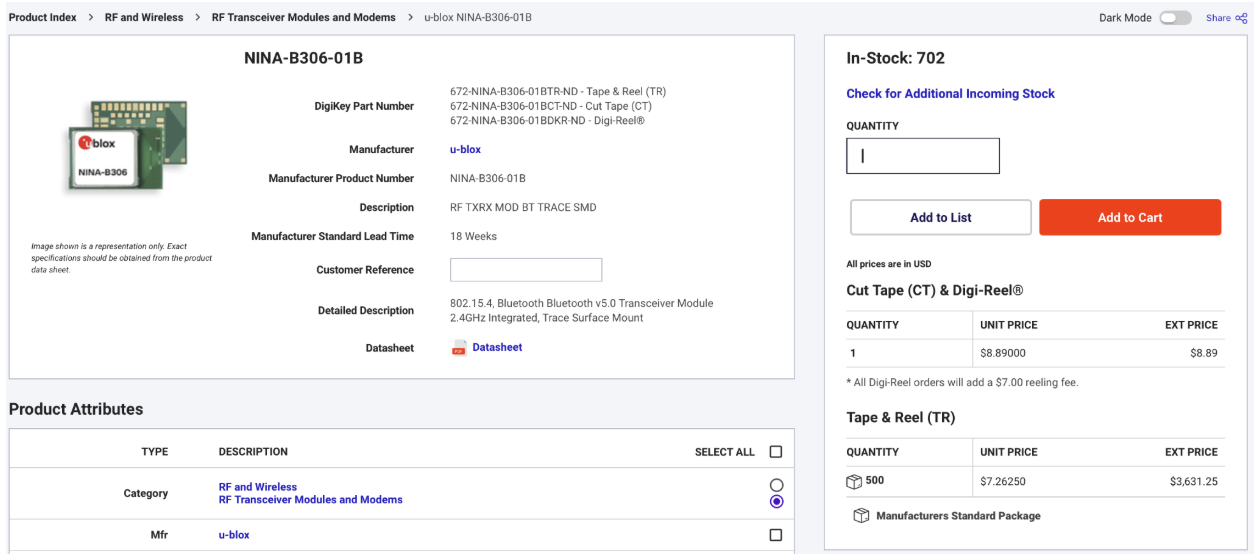
At quantities of at least 100,000 units, the difference in the processor alone amounts to $352,000. At higher quantities, the cost of an RF engineer and the additional certification required for a chip-down design would more than cover the difference.
Form factor is another reason for choosing a chip-down design over a module. Modules have a fixed footprint, and they’re usually larger than what a chip-down design would offer. Additionally, your team has much more flexibility in component placement with a chip-down design. If your product is size-constrained, in the case of a wearable, an in-ear device, or a miniature sensor, opting for a chip-down design lets your team optimize board real estate and potentially move to a smaller and denser PCB.
A chip-down design also gives you greater design control and flexibility than choosing a module. Yourteam can choose their own antenna design, whether it’s a chip antenna, a PCB antenna, or an external antenna attached via a connector. Your team can choose the appropriate matching network for your product’s specific enclosure and tune the performance for your operating environment. This level of control matters when your product has unusual mechanical constraints or operates in challenging RF environments.
Finally, a chip-down design exchanges simplicity in supply chain management with flexibility. Whereas with a module, you only have to manage a single item in your BOM for the processor, if there are issues with the vendor or supply chain for that component, you may have to scramble to find other suppliers or potentially redo your design. With a chip-down design, your team is not locked into the module vendor’s choice of SoC, flash size, or oscillator. If a part becomes obsolete or you need to increase the flash size to accommodate new features, you can update your design accordingly.
How to decide?
In my experience, the decision between choosing a module or a chip-down design comes down to where you are in the product design lifecycle. If you are in the early stages, you most likely don’t have significant volume, and your team is probably lean and doesn’t have the requisite expertise to perform a chip-down design. Additionally, it makes the most sense to sacrifice per-unit cost to minimize the initial non-recurring engineering (NRE) cost associated with certification and to reduce the time-to-market. However, once you are ready to enter production volume (usually greater than 50,000 units), you cannot ignore the per-unit cost. At this stage, it makes more sense to invest in the initial NRE cost for a chip-down design to achieve greater cost savings at scale.
The ideal approach is to plan for a hybrid path. Start with a module when designing your first iteration to get to market quickly, validate the product, and generate revenue. Once you have validated your product, you can use the generated revenue to offset the NRE cost of the chip-down design, resulting in significant savings at scale.
There is no universally "correct" answer here. The right choice depends on where you are in your product journey, your team's strengths, your target price point, and your volume projections. What matters most is making this decision intentionally, with a clear understanding of the tradeoffs, rather than defaulting to one approach because it's familiar.
If you need help with your product design, please reach out to us at mab@hellocoopercollective.com